
- Domain
What Is a Domain Name and Where Do You Buy One? (Beginner Guide)
By Ehasanul Haque
Posted on October 9, 2026
Want your own spot on the internet?
Then you need a domain name. It’s the first thing you buy, before hosting, before WordPress, before a single page exists.
Pick the right one and buy it from the right place, and you’ll never think about it again. Get it wrong, and you’ll pay too much every year or, worse, lose it.
Don’t worry. You don’t need to be technical to understand domains. It’s simpler than it sounds.
In this guide, I’m going to answer what is a domain name, how it works, what it really costs, where to buy one, and how to keep it safe for years.
There are 401.6 million registered domain names in the world right now (Verisign, Q2 2026). By the end of this post, you’ll know exactly how to add yours.
Let’s dive right in.
Key Takeaways
- A domain name is your website’s address: the name people type, like onylogy.com, instead of a string of numbers.
- It’s separate from hosting: the domain is the address, the hosting is the house. You usually pay for both.
- You rent it, you don’t own it: you register a name for 1 to 10 years and renew it, or it goes back on sale.
- Judge the renewal price, not the promo: the first year is the advert. Year two is the real price.
What Is a Domain Name? (Quick Explanation)
A domain name is the human-friendly address of a website, like google.com, that you type into a browser instead of the server’s numeric IP address.
Every website lives on a computer called a server. That server has an address made of numbers, like 192.0.2.44.
Nobody wants to remember that.
So we use names instead. You type the name, and the internet quietly looks up the number behind it.
That’s it. A domain name is a shortcut that humans can read and computers can follow.
It also does a second job. Your domain gives you a professional email address, like hello@yourbusiness.com, which looks far more trustworthy than a free Gmail address.
How Does a Domain Name Work?
A domain name works through the Domain Name System (DNS), a worldwide directory that turns names into server addresses in a fraction of a second.
Think of DNS as the internet’s phone book. You know the name. DNS finds the number.
Here’s what happens when someone types your domain:
- Their browser asks a DNS resolver, usually run by their internet provider, “Where does this name live?”
- The resolver asks the servers in charge of the extension (for .com, those are run by a company called Verisign).
- Those servers point to your domain’s nameservers, the ones your registrar or host set up for you.
- Your nameservers reply with your server’s IP address.
- The browser connects to that server and loads your website.
All of that takes milliseconds. Your visitor never sees any of it.
The good news? You’ll rarely touch DNS yourself. When you buy hosting, your host tells you which nameservers to use, you paste them in, and you’re done.
What Is a Domain Name Made Of?
Every domain name has two main parts, read from right to left: the extension and the name itself.
Take blog.onylogy.com as an example:
- .com is the top-level domain (TLD), also called the extension.
- onylogy is the second-level domain, the part you actually choose and register.
- blog is a subdomain, an optional prefix you can create for free once you own the domain.
The “www” you sometimes see is just a subdomain too. Most sites today work with or without it.
What Is a Domain Name Extension?
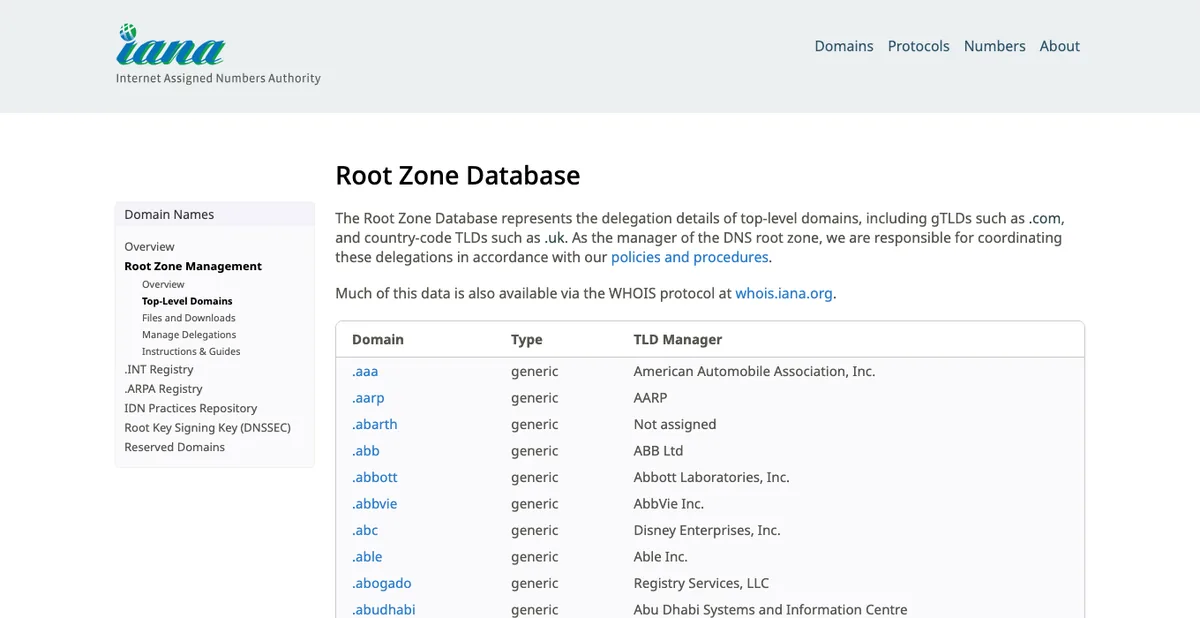
A domain name extension is the ending after the last dot, like .com or .org.
There are 1,437 live top-level domains on the official list kept by the Internet Assigned Numbers Authority (IANA), as of October 2026. They fall into three groups:
- Generic extensions: .com, .net, .org. Open to anyone. .com is still the one people remember.
- Country extensions: .uk, .de, .in, .bd. Great if your business serves one country. Some have local rules.
- New extensions: .shop, .blog, .studio, .dev. Fun and descriptive, but often pricier to renew.
Which one should you pick? If the .com is available at a fair price, take it. The guide to choosing a domain name walks you through that decision step by step.
Domain Name vs Web Hosting: What’s the Difference?
A domain name is your website’s address, while web hosting is the space on a server where your website’s files actually live.
Here’s the easiest way to picture it:
- Domain name = your street address.
- Web hosting = the house.
- Your website = everything inside the house.
You need all three. An address with no house leads nowhere. A house with no address is impossible to find.
But here’s the catch. Beginners often think buying a domain gives them a website. It doesn’t.
You buy the domain from a registrar, and the hosting from a hosting company. Sometimes one company sells both, which is convenient. They’re still two separate products with two separate bills.
If you’re still picking a host, our list of beginner-friendly WordPress hosting providers is the place to start.
What Is a Domain Name Registration, and Do You Own It?
Not quite. You don’t buy a domain name forever. You register the right to use it for a set period, then renew it.
Most registrars let you register a name for 1 to 10 years at a time. Ten years is the maximum for .com and most other extensions.
As long as you keep renewing, the name is yours. Nobody can take it from you just because they want it.
Stop renewing, though, and it goes back on sale. Someone else can grab it.
Who’s in charge of all this? Three groups:
- ICANN, the nonprofit that sets the rules for domain names worldwide.
- The registry, the company that runs one extension (Verisign runs .com).
- The registrar, the shop you buy from, like Namecheap or GoDaddy.
You only ever deal with the registrar. That’s the simple part.
How Much Does a Domain Name Cost?
A typical .com domain costs about $11 to $23 a year to renew, depending on where you buy it. New extensions and premium names can cost a lot more.
Here’s where beginners get caught out.
The first year is almost always discounted. Some registrars advertise a domain for one cent. Then year two arrives at the full price.
So always look for the renewal price before you buy. That’s the number you’ll pay every year after.
On the registrars we compared, a .com renewed for between about $11 and $23 a year when we checked in September 2026. For a real example, onylogy.com is registered at Namecheap and costs about $15 a year. That’s the whole bill.
Prices are going up, too. On November 1, 2026, Verisign raises the wholesale .com price from $10.26 to $10.97 a year (Domain Name Wire, April 2026). Registrars pass that on, so expect most .com renewals to rise by around a dollar.
What about a “free domain”? Many hosts include one free for the first year with a hosting plan. It’s a real perk. Just check what it renews at in year two.
Where Can You Buy a Domain Name?
You buy a domain name from a domain registrar. Hundreds of them exist, and the choice matters more than most beginners think.
What Is a Domain Name Registrar?
A domain name registrar is a company accredited to register names on your behalf and renew them every year.
There are hundreds of registrars. For a beginner, these six cover almost every situation.
1. Namecheap: The Safe Default
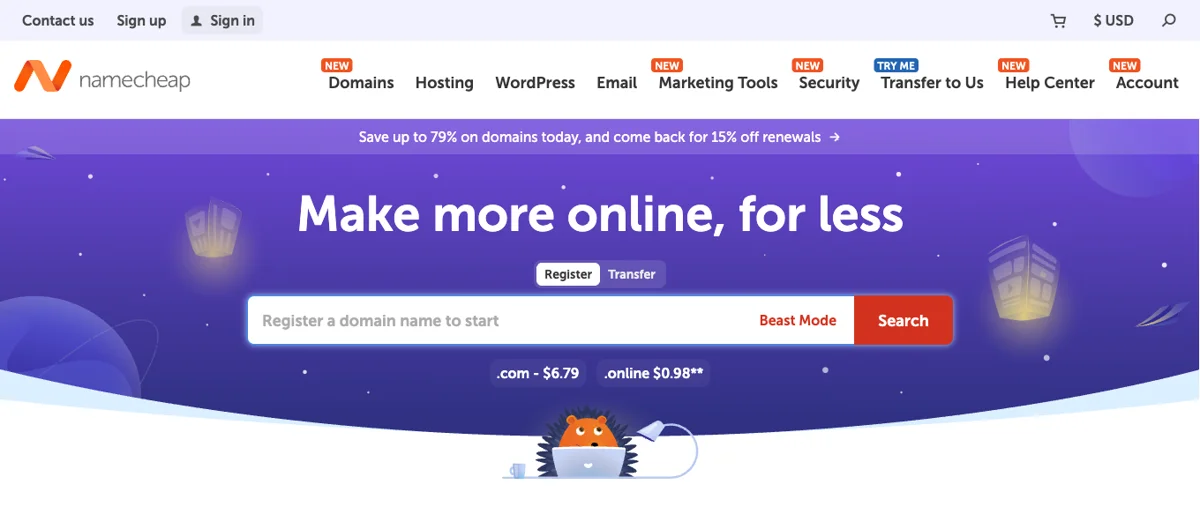
Namecheap is the registrar most beginners can pick without a second thought. It’s also where onylogy.com lives, at about $15 a year.
The homepage advertised a .com at $6.79 for the first year when we checked in October 2026. The renewal was $14.98 when we checked in September 2026, and that’s the number that matters.
Privacy protection is free for life, not just for year one. The dashboard is plain, the upsells are mild, and moving a domain out later is a button plus a code.
Best for: beginners who want to set it up once and forget it.
2. Hostinger: The Bundle
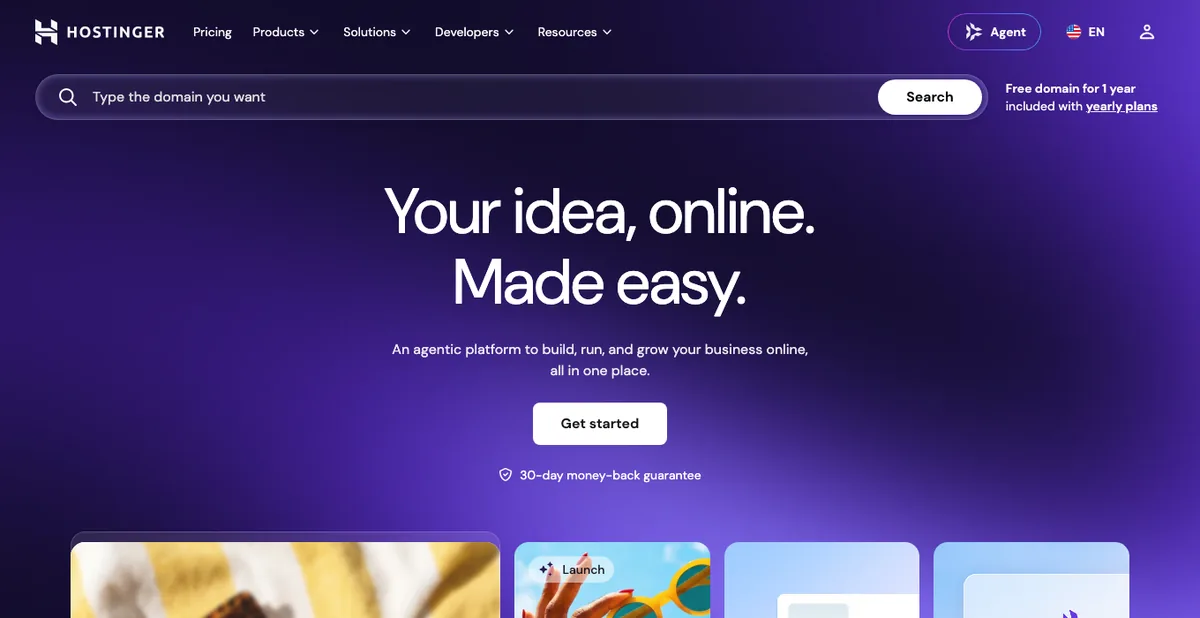
Hostinger makes sense if you’re buying your hosting there anyway. Its yearly hosting plans include a free domain for the first year.
One account, one login, one bill. The domain is already connected to your hosting, so there’s less to get wrong on a first site.
The trade is the renewal. A .com renewed at $19.99 when we checked in September 2026, about $5 more than Namecheap. You can always move the domain later.
Best for: beginners buying Hostinger hosting who want everything in one place.
3. GoDaddy: The Big One
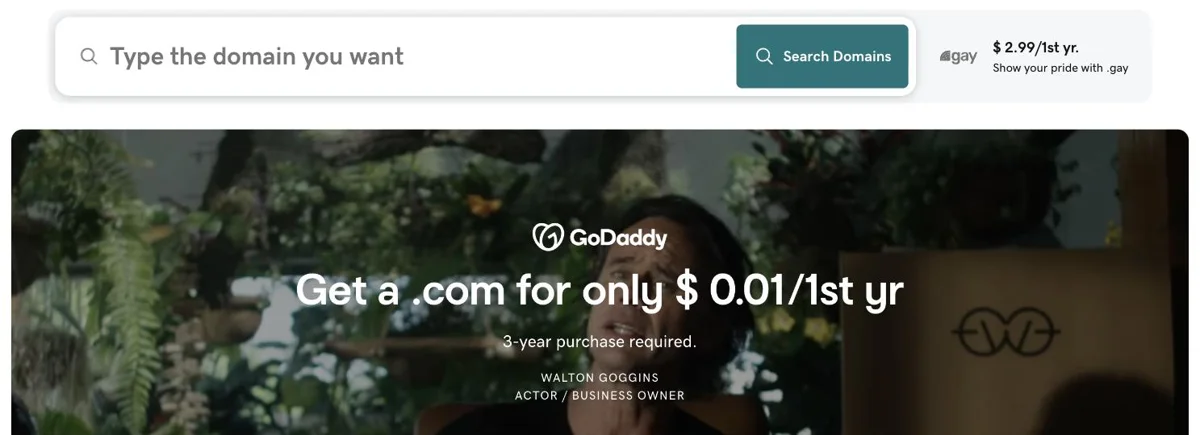
GoDaddy is the largest registrar in the world, and it has been selling domains since 1997.
Its homepage headline was a .com for $0.01 in October 2026. Read the small print, though: a 3-year purchase is required, and the .com renewed at $22.99 when we checked in September 2026, the highest of these six.
The upside is 24/7 phone support and a dashboard that handles hundreds of domains. The downside is a checkout full of extras. Say no to everything you didn’t come for.
Best for: people who want phone support and don’t mind paying more for it.
4. Cloudflare Registrar: The At-Cost Option
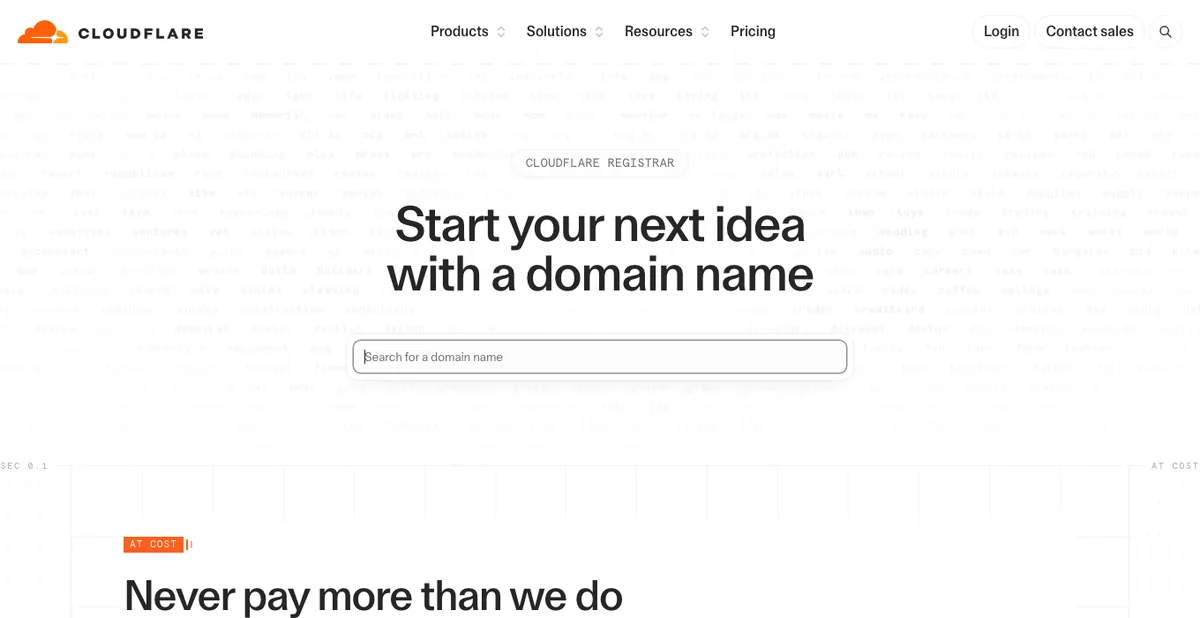
Cloudflare Registrar sells domains at cost. It charges only what the registry and ICANN charge, with no markup, no promo and no renewal jump.
That makes it the cheapest place to keep a .com long term. Privacy is free, and so is one-click DNSSEC, an extra security layer for your domain.
There’s one real catch. Every domain on Cloudflare Registrar must use Cloudflare’s own nameservers, so your DNS settings live in Cloudflare, not at your host.
Best for: beginners happy to manage DNS in Cloudflare who want the lowest long-term price.
5. Porkbun: The Honest Bargain
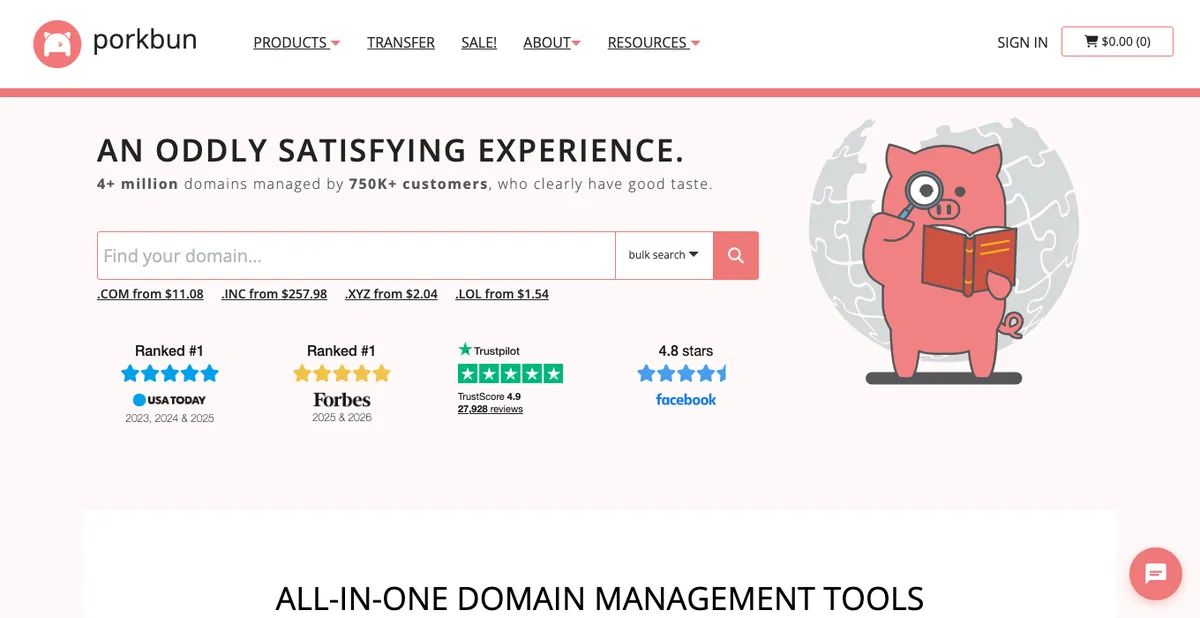
Porkbun has a cartoon pig for a mascot and some of the fairest prices in the business.
A .com was $11.08 for both the first year and every renewal when we checked in September 2026, and its homepage still showed $11.08 in October 2026. No bait price, no surprise in year two.
Privacy is free, and so is an SSL certificate. It’s a smaller company than the others, though, and support is mostly by email.
Best for: beginners who want a low renewal without Cloudflare’s DNS rule.
6. Squarespace Domains: The Google Domains Successor
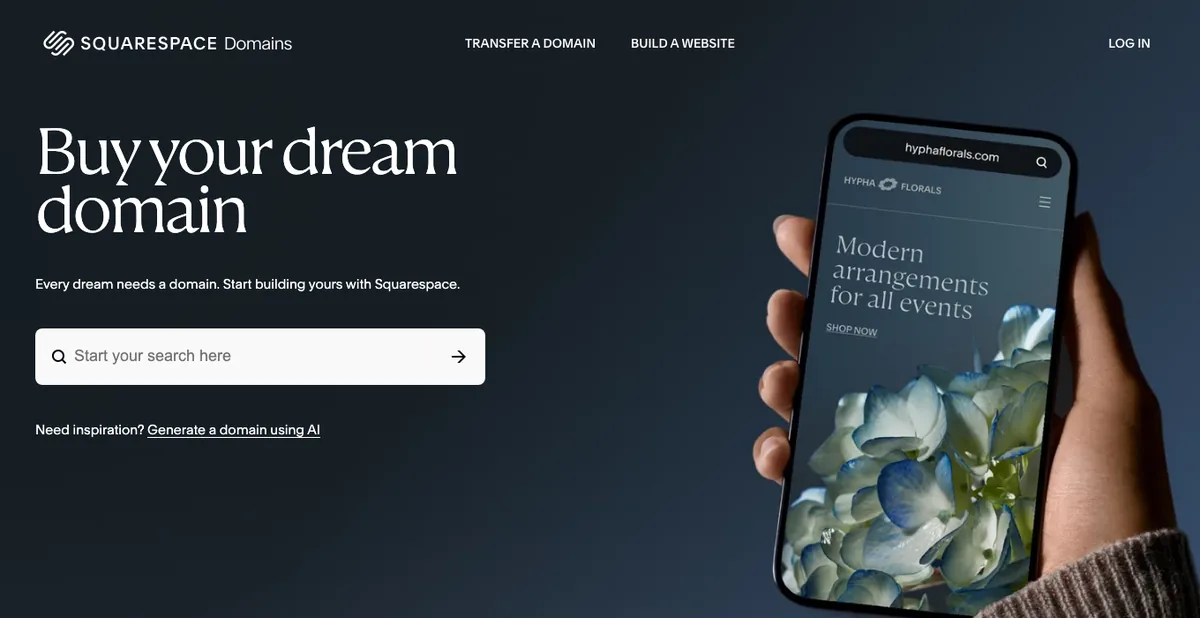
Squarespace Domains is where Google Domains customers ended up after Google sold that business to Squarespace in 2023.
It kept what people liked: clean pages, simple pricing and privacy included. Email forwarding is free, and it works with any host, not just Squarespace websites.
It isn’t cheap, though. A .com renewed at about $20 a year when we checked in September 2026.
Best for: former Google Domains users and Squarespace website owners.
Here’s the quick view:
| Registrar | Best for | Free privacy | The catch |
|---|---|---|---|
| Namecheap | Set it up once and forget it | Yes, for life | Not the very cheapest |
| Hostinger | Hosting and domain in one account | Yes, on most extensions | Higher renewal |
| GoDaddy | Phone support | Yes | Highest renewal, heavy upsells |
| Cloudflare | Lowest long-term price | Yes | Must use Cloudflare DNS |
| Porkbun | Cheap with no tricks | Yes | Smaller support team |
| Squarespace | Squarespace website owners | Yes | Pricier than the rest |
Want the full comparison with prices and screenshots? Read our roundup of the best domain registration websites. It ranks all six by what they cost in year two.
How to Buy a Domain Name (Step by Step)
Buying a domain takes about ten minutes. Here’s the whole process:
- Choose your name. Say it out loud and check it isn’t someone’s trademark.
- Search it on your registrar’s site. If it’s taken, try a shorter version or a different extension.
- Pick the registration length. One year is fine. Longer terms protect you from forgetting.
- Skip the upsells. You don’t need their email bundle, website builder, or paid SSL to start.
- Make sure privacy is switched on. It should be free.
- Pay and create your account. Use an email address you’ll still have in five years.
- Turn on auto-renew and two-factor login. These two settings prevent most domain disasters.
That’s it. The name is yours.
Next, you connect it to your hosting by changing the nameservers, then install WordPress. Our step-by-step WordPress install guide picks up right there.
A real lesson from this site: two Onylogy products were renamed after a name clash turned up late. Check trademarks before you buy a domain. It takes two minutes and saves you a rebrand.
What Is WHOIS Privacy, and Do You Need It?
WHOIS privacy hides your name, home address, and phone number from the public record that every domain has.
When you register a domain, you have to give your real contact details. For years, anyone could look them up.
That’s how spammers and scammers found new site owners.
Today, most registrars hide those details for free. You should always keep that protection on.
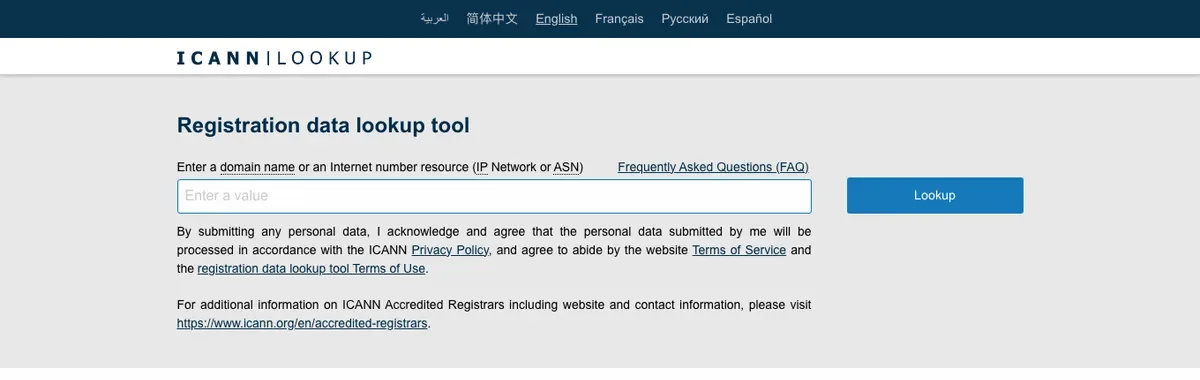
The lookup system has a new name, too. Since January 28, 2025, ICANN uses a newer system called RDAP in place of the old WHOIS service. You can try it yourself with ICANN Lookup: type any domain, and you’ll see its registrar and expiry date.
What Happens If Your Domain Expires?
If your domain expires, your website and email stop working, but you usually have a few weeks to renew it before anyone else can buy it.
Here’s the real timeline for a .com, based on ICANN’s rules:
- Before expiry: your registrar must email you about one month and one week ahead.
- Right after expiry: your site and email go offline. You can usually still renew at the normal price for a short time, which varies by registrar.
- Redemption period (30 days): the name is deleted but still recoverable. You’ll pay the renewal plus a redemption fee, often far more than a normal year.
- Pending delete (about 5 days): nobody can rescue it now.
- Released: the name goes back on sale to anyone.
Sounds scary? It’s easy to avoid. Turn on auto-renew, keep a valid card on the account, and use an email you actually read.
Can You Get a Professional Email With Your Domain?
Yes. Once you own a domain, you can create email addresses like you@yourdomain.com through an email hosting service.
Your registrar or host may include basic email. Services like Google Workspace or Microsoft 365 are the popular paid options.
Setting it up means adding a few DNS records your email provider gives you. You copy, you paste, you save.
Plain and simple.
If you want to go further (email authentication, moving registrars, DNS records, security), that’s all in our advanced domain management guide.
Common Domain Mistakes Beginners Make
Most domain problems come from a handful of easy mistakes:
- Letting a developer register it in their own account. Always register your domain in your own name and your own account.
- Using a work or school email for the account. If you lose that inbox, you lose your renewal reminders.
- Buying only on the first-year price. Check the renewal price every time.
- Saying yes to every upsell. A $10 domain can turn into a $60 checkout in two clicks.
- Forgetting auto-renew. It’s the number one reason people lose domains they wanted to keep.
- Picking a name that’s hard to spell. If people can’t type it after hearing it once, they won’t find you.
Avoid these six, and you’re ahead of most new site owners.
What to Do Next
You know what a domain name is. Now it’s time to get yours:
- Choose the name: follow our domain name guide and its three simple tests.
- Buy it: pick a registrar from the registrar roundup.
- Get hosting: compare the top hosting providers for WordPress.
- Build the site: if WordPress is new to you, start with what WordPress is and why people use it.
Final Thoughts
So, what is a domain name? It’s your address on the internet. It’s cheap, it’s simple, and it’s the first step to having a website that’s truly yours.
Buy it from a registrar with fair renewals and free privacy. Turn on auto-renew. Keep it in your own account.
Do those three things, and your domain will quietly work for you for years.
Over to you: have you already picked a name, or are you still deciding? Let me know in the comments.
Frequently Asked Questions
What is a domain name in simple words?
A domain name is your website’s address, like example.com. People type it into a browser to find your site instead of remembering a numeric IP address.
What is a domain name compared to a website?
A domain name is only the address, not the website itself. You also need web hosting to store your website’s files and a platform like WordPress to build the pages.
How much does a domain name cost per year?
A .com usually costs about $11 to $23 a year to renew. The first year is often cheaper, so always check the renewal price before you buy.
Can I buy a domain name forever?
No. You can register a domain for up to 10 years at a time, then renew it. As long as you keep renewing, nobody else can take it.
Where is the best place to buy a domain name?
For most beginners, Namecheap or Porkbun offer fair renewal prices and free privacy. Cloudflare is the cheapest long term if you’re happy using its DNS.
What is a domain name used for besides a website?
Your domain also powers your professional email address, like you@yourbusiness.com. You can use it for subdomains, such as a shop or a blog, too.
Can I get a domain name for free?
Many hosting companies include a free domain for the first year with a hosting plan. After that, you pay the normal renewal price.
What happens if someone already owns the domain I want?
You can try a different extension or a slightly different name. You can also contact the owner through the registrar, but buying a taken domain is often expensive.
Can I move my domain to another registrar later?
Yes. You can transfer a domain to another registrar after the first 60 days, using a transfer code from your current registrar.
You May Also Like
-

Domain Management for Advanced Users
Bought your domain, pointed it at your host, and never… -
Top 6 Domain Registration Websites
Ready to buy your domain name? Here’s the first thing… -
How to Choose a Domain Name
Picking a name for your website? It feels like the…