
- WordPress
llms.txt for WordPress: The Complete Guide (And the Honest Evidence)
By Ehasanul Haque
Posted on October 1, 2026
Somebody told you that you need an llms.txt file, or your site will vanish from AI search.
Your SEO plugin may even have offered to make one for you.
So here is the honest answer up front, before you spend an afternoon on it: the evidence that llms.txt helps you get cited by AI right now is weak. Studies of hundreds of thousands of sites have found no measurable benefit, and Google has said publicly that it does not use the file.
That is not the answer most articles give. It is the one the data supports.
Don’t worry though, this is not a “don’t bother” post. There is a real reason to have one, it just isn’t the reason you were sold.
This guide covers what the file is, the exact format, how to make one on WordPress, what the research actually found, and how to decide whether it’s worth your time.
Let’s get into it.
Key Takeaways
- What it is: a proposed markdown file at your site root that hands AI tools a curated map of your best content.
- Who proposed it: Jeremy Howard, in September 2024. It is a proposal, not a standard anyone has adopted.
- Does it work for AI search? There is no good evidence that it does. A 300,000 domain study found no link to AI citations, and Google says it does not use it.
- Should you make one? If your SEO plugin generates it in one click, sure. Do not build one by hand expecting traffic.
What Is an llms.txt File?
An llms txt file is a markdown file at your site’s root that gives AI tools a short, curated guide to your most useful pages.
The idea behind it is reasonable enough. An AI agent landing on your site has to wade through navigation, cookie banners, sidebars, and footers to find the actual content.
An llms txt file skips that. Here is who we are, here are the pages that matter, in a format a language model reads easily.
It lives at:
https://yourdomain.com/llms.txtThe official proposal puts it this way: it is “a proposal to standardise on using an /llms.txt file to provide information to help agents use a website”.
Note that word. Proposal.
Who Proposed llms.txt, and When?
It was proposed by Jeremy Howard, published on 3 September 2024 (llmstxt.org, checked September 2026). The spec page is now on version 2, last modified in August 2026.
Howard is a well known figure in machine learning, which is part of why the idea spread quickly.
Here is what matters, though. A proposal becomes a standard when the people it is aimed at adopt it.
robots.txt became a standard because every crawler honoured it. That is the bar, and llms txt has not cleared it.
What Does an llms.txt File Look Like?
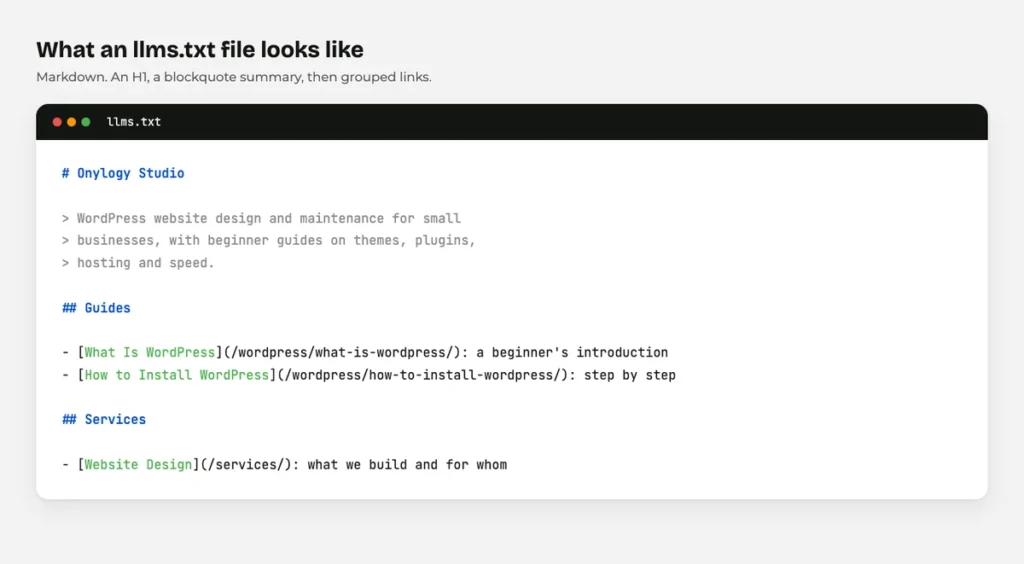
The format is markdown, and it is genuinely simple.
The spec requires a specific order:
- An H1 with your site or project name. This is the only required part.
- A blockquote with a short summary.
- Optional paragraphs with more detail.
- Any number of H2 sections, each holding a list of links.
Each link is written as a normal markdown link, optionally followed by a colon and a note.
Here is a complete example for a small WordPress business site:
# Onylogy Studio

> WordPress website design and maintenance for small businesses,
> with beginner guides on themes, plugins, hosting and speed.

## Guides

- [What Is WordPress](https://example.com/wordpress/what-is-wordpress/): a beginner's introduction
- [How to Install WordPress](https://example.com/wordpress/how-to-install-wordpress/): step by step

## Services

- [Website Design](https://example.com/services/): what we build and for whom
That’s it. A heading, a summary, and some grouped links.
One clarification worth making, because plenty of articles get it wrong. The spec page does not mention llms-full.txt at all (checked September 2026). That variant is something the wider community invented, not part of the proposal.
Where Does the File Go?
At your site root, usually. The spec allows more flexibility than most people realise.
It can sit “at the site root, or at any path within it, covering the pages under that path”. If several apply to a request, an agent should use “the most specific one”.
In practice, for a WordPress site, put it at the root and stop thinking about it.
Does llms.txt Actually Work? The Evidence
This is the section other guides skip, so let’s go through it properly.
The big study
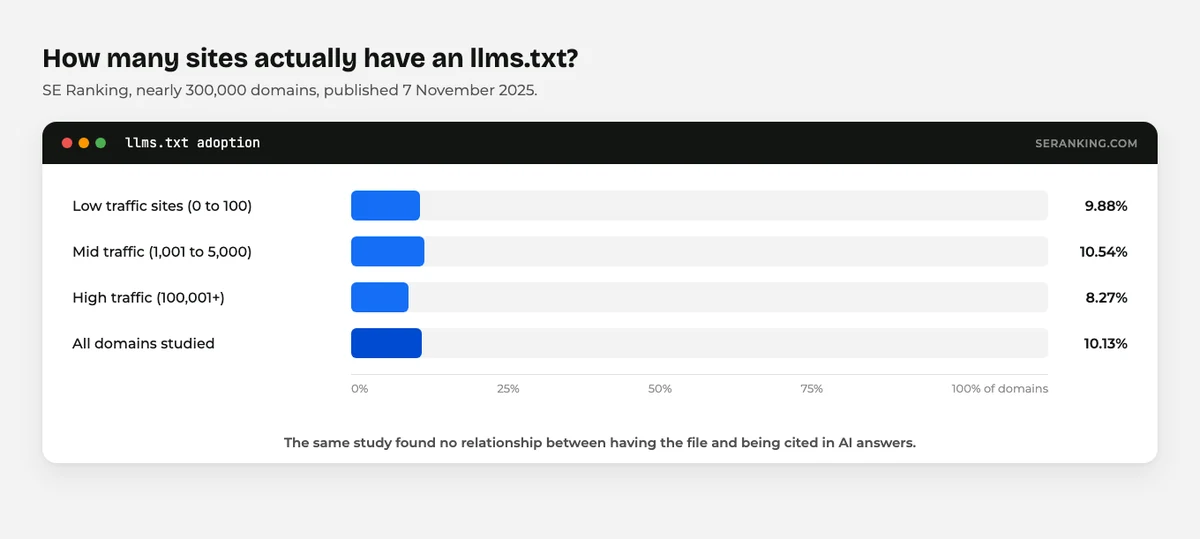
SE Ranking analysed nearly 300,000 domains and published the results on 7 November 2025 (SE Ranking).
Two findings matter.
Adoption is around 10%. Exactly 10.13% of domains had the file. Uptake was flat across site sizes: 9.88% for low traffic sites, 10.54% for mid traffic, and 8.27% for high traffic sites.
Read that last number again. The biggest sites were the least likely to have one.
It showed no link to AI citations. The study found no relationship between having an llms txt file and how often a domain got cited in AI answers.
The detail that stuck with me is what happened to their model. When the researchers removed llms.txt as a variable, their predictions actually improved. The file was adding noise, not signal.
Search Engine Journal covered the study on 20 November 2025 under a headline that summarises it well: llms.txt shows no clear effect on AI citations (Search Engine Journal).
What Google has said
Google has been unusually direct about this.
Gary Illyes has stated that Google does not support llms.txt and has no plans to. John Mueller compared the idea to the old keywords meta tag, a signal Google abandoned long ago because site owners controlled it and therefore gamed it.
That comparison is the important one. Anything you declare about yourself is worth less to a search engine than what it can verify itself.
So why does everyone recommend it?
Three reasons, and none of them are evidence.
It is easy to write about. It sounds like a concrete action in a field where most advice is vague. And plugins added a button for it, so it became a checklist item.
None of that makes it work.
A note on who benefits from the hype
Worth asking who gains when a new file becomes a checklist item.
Plugin makers get a feature to announce. Agencies get a service to sell. Bloggers get an easy post. None of them have to prove it works.
You are the one spending the time, so you are the one who should ask for evidence.
That is not cynicism about the idea itself. Jeremy Howard’s proposal is thoughtful and the format is well designed. The gap is between the proposal and what the industry has actually adopted, and that gap is where your afternoon disappears.
Apply the same test to the next thing someone tells you that you must add. Who measured it, on how many sites, and when?
So Should You Add llms.txt to Your WordPress Site?
Here is how I would decide, and it comes down to effort.
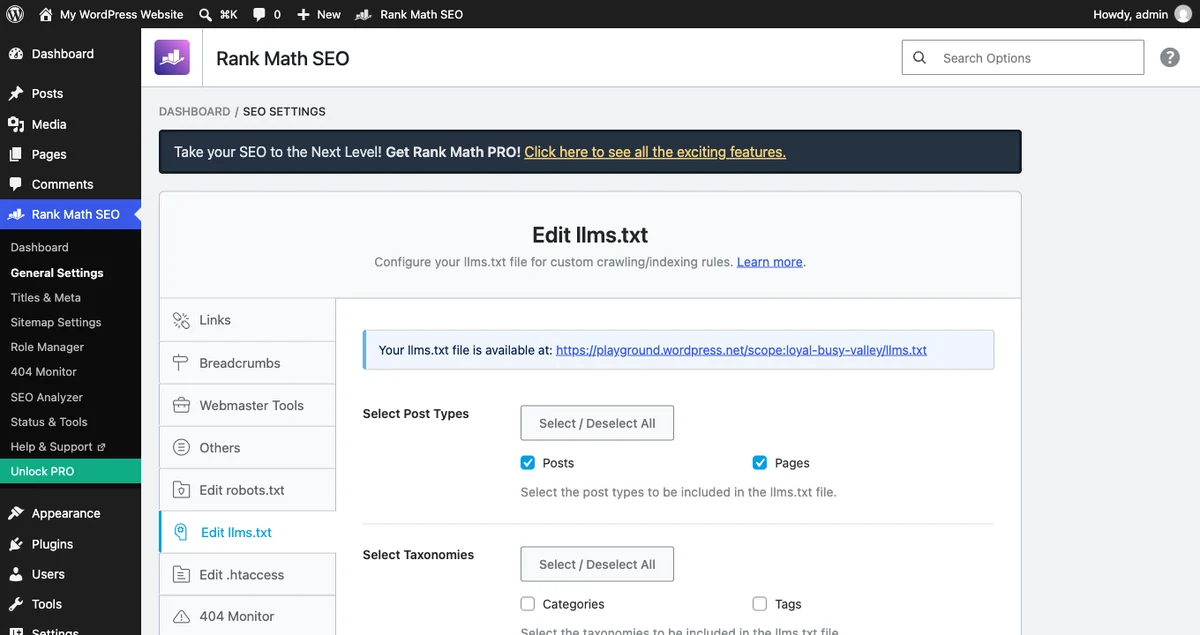
If your SEO plugin generates it in one click: go ahead. Both Rank Math and Yoast ship a generator. It costs you thirty seconds, it cannot hurt, and if adoption changes you are already set up.
If it means writing and maintaining the file by hand: don’t. You will spend hours on something with no demonstrated return, and every time you publish a post the file goes slightly more out of date.
If someone is selling you llms txt setup as an AI SEO service: ask them for evidence. The 300,000 domain study is the best data available and it does not support the pitch.
That is the whole decision. Cheap and automatic, fine. Expensive and manual, no.
How to Add an llms.txt File to WordPress
If you have decided you want one, here are your three routes, easiest first.
Route 1: let your SEO plugin do it
Check your SEO plugin’s settings first, because you may already have the option.
Both major SEO plugins now have one. Yoast shipped the first llms.txt generator in an SEO plugin in June 2025, and Rank Math added an LLMS Txt module you enable from Rank Math SEO > Dashboard, then configure under General Settings > Edit llms.txt (Rank Math knowledge base, checked September 2026).
Flip the switch and you’re done. Rank Math builds the file from your real post types and leaves out anything you have marked noindex.
The plugin builds the file from your actual content and keeps it current as you publish. That is the whole appeal, and it costs you nothing to maintain.
Route 2: use a dedicated plugin
If your SEO plugin does not offer it, a small single purpose plugin will.
Search the plugin directory for llms.txt and you will find several. Check the last updated date and the active install count before you install anything, as you would with any plugin.
Do you need one? Only if you actively want the file and your SEO plugin cannot make it.
Route 3: write it yourself
You can create the file by hand and upload it to your site root, next to wp-config.php.
Write it in any text editor, save it as llms.txt, and upload it over FTP or through your hosting file manager.
Then test it. Visit yourdomain.com/llms.txt in your browser, and if you see your text, it works.
Be honest with yourself about the maintenance, though. Every post you publish makes a hand written file slightly more out of date, and nobody remembers to update it after the first month.
Does your theme or host block it?
Occasionally. Some managed hosts intercept requests for unknown root files.
If you uploaded the file and the address returns a 404, that is worth a quick support ticket before you spend longer on it.
Where llms.txt Genuinely Does Get Used
Now for the fairer part of the picture, because “no effect on AI search” is not the same as “nobody reads it”.
The file has found a real audience, just not the one it was marketed for.
Coding agents and developer tools fetch llms.txt to understand a library or an API quickly. If you publish documentation, this is a genuine use case.
Documentation sites are where adoption is concentrated. SaaS products, open source projects, and API references.
Notice what those have in common? They are all technical documentation being read by a machine that needs to use it, not a marketing site hoping to be quoted.
If your WordPress site is a business site or a blog, that isn’t you. If you publish developer documentation, it might be.
What to Do Instead for AI Search
If your actual goal is getting cited by ChatGPT, Claude, Perplexity, or Google’s AI answers, here is where the effort belongs.
Write clear, self contained answers. AI systems lift passages. A paragraph that makes sense on its own is far more quotable than one that depends on three paragraphs above it.
Put the answer first under every heading. Ask the question in the heading, answer it in the first sentence, then explain. That single habit does more than any file.
Use headings people actually type. “What Is an llms txt File?” beats “Setting the Scene”.
Cite your sources with dates. A model repeating your claim wants something to attribute. Name the source and the year in the sentence.
Get your robots.txt right. This one genuinely matters, and it is the opposite of llms.txt. AI crawlers do respect robots.txt, so blocking the wrong bot really will remove you from AI answers. Our robots.txt guide covers which tokens do what.
Make sure your content can be found at all. A working sitemap and solid WordPress SEO basics still do the heavy lifting.
Every one of those is worth more than an llms txt file. None of them is as easy to sell.
Common llms.txt Mistakes
Five, and the first is by far the most expensive.
Treating it as an AI ranking factor. It isn’t one, on the evidence available. The fix: spend that time on the content itself.
Confusing it with robots.txt. They do opposite jobs. robots.txt controls access and is universally respected. llms txt suggests content and is mostly ignored. The fix: if you only get one right, get robots.txt right.
Listing every page you have. The whole point is curation. A dump of 400 URLs is just a worse sitemap. The fix: list the pages you would actually want quoted.
Letting it go stale. A hand written file drifts out of date within weeks. The fix: generate it with a plugin or accept it will age.
Adding llms-full.txt because a blog post said to. It is not in the spec. The fix: follow llmstxt.org, not third party summaries.
Will This Change?
It might, and that’s a fair reason to keep a cheap generated file in place.
Adoption at 10% is not nothing. If a major AI company announced tomorrow that it reads llms.txt, the picture changes overnight and you would want one already live.
That is the honest case for having one: it is a lottery ticket that costs you almost nothing if a plugin prints it.
What it is not is a fix for a site that isn’t being cited. That problem is nearly always the content.
Worth revisiting in a year. If you read this and the date is well past 2026, check for newer evidence before you act on any of it, including this post.
Final Thoughts
llms txt is a sensible idea that the industry has not adopted, being sold as a solution to a problem it does not currently solve.
The best available study looked at 300,000 domains and found no connection to AI citations. Google has said plainly that it does not use the file. Most of the sites getting cited in AI answers do not have one.
So: if your SEO plugin makes one in a click, let it. If not, put those hours into clear writing, answer first headings, and a correct robots.txt.
That is less exciting than a new file. It is also what actually works.
For everything else on your site, our guide to WordPress file types is the map, and the SEO plugins roundup covers which one to run.
Over to you: has anyone tried to sell you an llms.txt setup? Tell me what they claimed in the comments.
Frequently Asked Questions
What is an llms.txt file?
It is a markdown file at your site root that gives AI tools a curated list of your most useful pages. It was proposed in September 2024 and is not an adopted standard.
Does llms.txt improve AI search rankings?
There is no good evidence that it does. A study of nearly 300,000 domains published in November 2025 found no relationship between having the file and being cited in AI answers.
Does Google use llms.txt?
No. Google representatives have said Google does not support the file and has no plans to, comparing it to the old keywords meta tag.
Should I add llms.txt to my WordPress site?
If your SEO plugin generates it automatically, there is no reason not to. Do not write and maintain one by hand expecting it to bring traffic.
What is the difference between llms.txt and robots.txt?
robots.txt controls which crawlers may access your pages and every major crawler respects it. llms txt suggests which content AI tools should read, and most currently ignore it.
Is llms-full.txt part of the specification?
No. The official proposal at llmstxt.org does not mention it, so it is a community addition rather than part of the spec.
Who actually reads llms.txt files today?
Mainly coding agents and developer tools fetching documentation. Adoption is concentrated in SaaS docs and open source projects rather than business sites and blogs.
You May Also Like
-

What Is Web Hosting
Want a website but have no idea where it actually… -
WordPress File Types Explained
Your WordPress site is made of files. Dozens of them,… -
What Is a JSON File?
You clicked a download button, and out came a file…